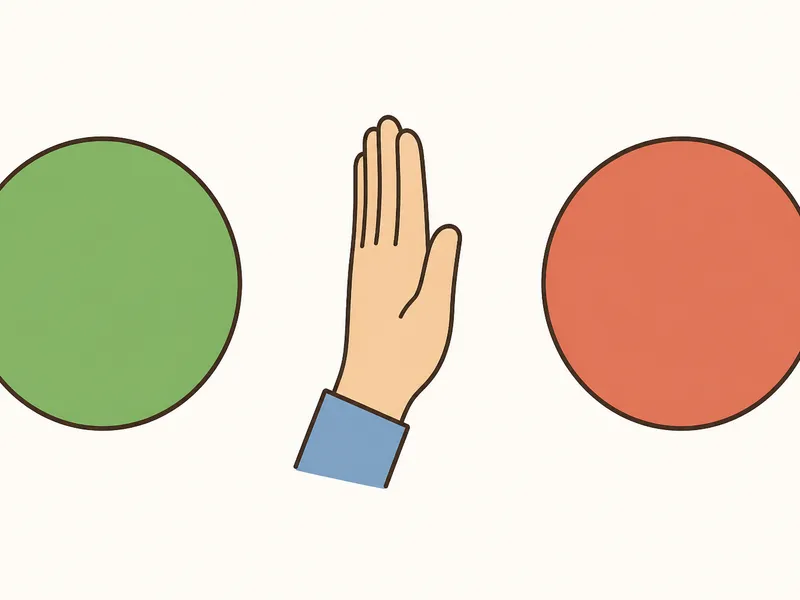
How to play
- 1
Tap when the screen turns green.
- 2
Do nothing when it turns red.
- 3
The pace speeds up; a wrong tap or a missed green ends the streak.
What this test measures
This game measures response inhibition plus reaction speed. You must act quickly on go-signals and withhold the same action on no-go signals.
Acting on one signal and not the other
The go/no-go task dates back to the beginnings of experimental psychology. In 1868 the Dutch scientist F. C. Donders compared three kinds of reaction: one response to one expected signal, a different response for each of several signals, and a response to one particular signal with none at all to the others. By subtracting one reaction time from another, he tried to measure how long the mind takes to tell signals apart and to choose a response. His third kind, the c-reaction, is the go/no-go task, and an English translation of the paper appeared a century later (Donders, 1969).
Today researchers use the task to study inhibitory control, the ability to stop an action that is ready to go. The design matters. In an EEG study, the brain's preparation to press showed up reliably only in fast tasks with rare no-go trials, and the activity linked to stopping was far weaker in slow tasks with equal numbers of go and no-go trials (Wessel, 2018).
There are two ways to fail. Tapping on a no-go signal is an error of commission; letting a go signal pass is an error of omission. Here either one ends the run.
Faster signals, more reds
The first signal arrives 0.4 seconds after you start, and each one is green or red at random. The odds shift as your streak grows: 35% of signals are red at the start, each point of streak adds 2 percentage points, and from a streak of 13 on, 60% are red.
A green has to be tapped within 900 milliseconds at first. Each point of streak takes 35 milliseconds off that window until it reaches 550 milliseconds at a streak of 10. A red stays up for the same window, and holding still until it disappears counts as a correct answer. The gap before the next signal shortens too, and a small random delay keeps the signals off a regular beat.
That makes the run two-sided. The early, mostly green stretch builds the habit of tapping, which is what makes a red hard to resist. Later the reds outnumber the greens, and the risk shifts toward letting a green slip by in a window of just over half a second. Your score is the streak: one point for each correct tap or correct hold. On the score guide, a streak of 8 to 14 is Average, 15 to 21 Focused, 22 to 29 Disciplined and 30 or more earns Monk.
Staying ready without jumping
Let the color decide, not the change. Every new signal arrives as a sudden burst of color, so wait until you know which color it is before you commit. Speed earns nothing extra: a tap late in the window scores exactly the same as an instant one.
Shift your default as the odds change. Up to a streak of 7, greens are more common than reds, so the color to watch for is red. From a streak of 8 on, reds are the majority, and the color to watch for is green.
Be most careful after several greens in a row, when tapping has become automatic and the next red is hardest to stop. Taps on the blank screen between signals are simply ignored, so tapping early gains nothing; the danger is a finger that lands just as a red appears.
Score guide
| Grade | Range |
|---|---|
| Monk | 30+ streak |
| Disciplined | 22–29 streak |
| Focused | 15–21 streak |
| Average | 8–14 streak |
| Impulsive | 4–7 streak |
| Twitchy | 0–3 streak |
FAQ
- How is the score counted?
- Your score is the streak of correct go and no-go responses in one run.
- What counts as a miss?
- Tapping on red, or failing to tap on green in time, ends the streak.
- Does it get faster?
- Yes. Later signals give you less time, so impulse control matters more.
- Is this a clinical impulse-control test?
- No. It is a short arcade-style challenge, not a medical evaluation.
Sources
- Donders, F. C. (1969). On the speed of mental processes. Acta Psychologica, 30, 412–431. (Original work published 1868)
- Wessel, J. R. (2018). Prepotent motor activity and inhibitory control demands in different variants of the go/no-go paradigm. Psychophysiology, 55(3), e12871.